
Today's NYT Spelling Bee Hints & Answer for Fri, October 2, 2026
Unlock the Pangram and reach Genius with our spoiler-free hints and grid, view the full answers, or search the archive.
Today's NYT Spelling Bee Hints
Puzzle Stats
- Total Words: 56
- Total Points: 257
- Pangrams: 1
- Genius: 180 Points
Pangram Hint(s)
Reveal Pangram Hint
Two-Letter List
Reveal Two-Letter List
Hint for a Long Word
Reveal Long Word Hint
Today's NYT Spelling Bee Answers
A Words (4)
I Words (3)
Pangram
L Words (4)
M Words (9)
N Words (2)
P Words (17)
T Words (17)
Today's NYT Spelling Bee Review & Analysis
- The required t is a consonant anchor rather than a vowel, so every viable word must include a stop consonant; with only a and i available as vowels, pronounceable lanes recycle them among l, m, n, and p. The strongest launch points are ta- (10 words) and ti- (7), which feed compact forms such as tail, taint, tall, tint, tilt, and titan and extend into taillamp, tatami, tilapia, and timpani. A second productive launch is pla- (5), supported by plant, plaint, plait, plat, and pliant. At the other end, -nt (13) is the broad harvesting tool, especially its -int (7) and -ant (6) branches; the internal ai bridge (10) supplies the vowel sequence behind attain, maintain, paint, plaint, and plantain.
- Implant is the sole pangram and has a compact derived shape: the assimilated prefix im- joins the plant base, producing a verb or noun rather than a compound. It contains both available vowels once and uses the PLA cluster directly, with plant one of the board’s five pla- words. Its final -ant also belongs to the productive -ant branch of the broader -nt harvesting family, while its internal m-p-l sequence shows how consonants carry the sparse two-vowel inventory. The pangram concentrates the board’s main expansion signals in seven letters.
How to Use Our Spoiler-Free NYT Spelling Bee Hints
Trying to reach Genius without spoiling the fun? Most players work through the hints in stages—starting with overall stats, then narrowing things down by letter groups, and only revealing full answers if they get stuck.
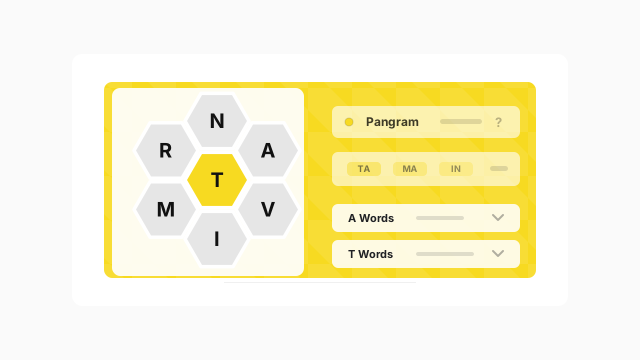
Puzzle Stats and the Pangram Hint
The "Puzzle Stats" section shows the Genius score and total number of answers. If you want a nudge, "Reveal Pangram Hint" gives a clue that points toward the pangram without giving it away.
Grid, Two-Letter List, and Long Word Hint
When you're down to a few missing words, the "Two-Letter List" helps identify unused starts like CA-2 or CO-3. You can also try "Hint for a Long Word", which offers a definition-style clue for one longer answer.
Answers Grouped by Starting Letter
In "Today's Spelling Bee Answers", words are organized by starting letter—A words, B words, and so on. The group that includes the pangram is marked with a ★ Pangram label.
Seeing the Full Solution
If you’re ready to see everything, "Reveal All Answers" expands every letter group and displays the complete list in alphabetical order, with the pangram highlighted.
FAQ
How do I use these Spelling Bee hints?
The page is kept spoiler-free by default. You can start with Puzzle Stats to see where the Genius score sits. The Two-Letter List (like CO-2) is helpful for spotting missing word starts. If you need more, the Answers section is grouped by starting letter, so you can reveal only what you want.
When do NYT Spelling Bee Hints update?
Hints update every day shortly after 3:00 AM ET, around the same time the official New York Times Spelling Bee goes live. We usually have the grid, pangram hints, and full answers posted within a few minutes.
How are Spelling Bee points calculated?
4-letter words are worth 1 point. Longer words score 1 point per letter (for example, a 6-letter word earns 6 points). Pangrams get an extra 7-point bonus on top of their letter total, which makes them a big boost toward Genius.
What do the numbers in the 'Two-Letter List' mean?
Each entry (such as CO-2 or DE-4) shows how many valid words begin with that letter pair. For example, 'CO-2' means there are exactly two words starting with 'CO'. It’s a way to narrow things down without giving answers away.
What is a Pangram in Spelling Bee?
A pangram is a word that uses all seven letters from the puzzle at least once. Every Spelling Bee has at least one. In the answer list, pangrams are marked with a ★ Pangram label.
Why are the answers hidden initially?
So you don’t see anything by accident. Answers stay hidden behind a Click to Reveal setup, letting you uncover a single hint, a group of words, or everything at once using the 'Reveal All Answers' button.
Can I find answers for past puzzles?
Yes. The Archive section at the bottom of the page lets you look up hints and answers for puzzles from the past year.